Showing posts with label Book Review. Show all posts

Tuesday, February 16, 2010

The Elegance of the Hedgehog By Muriel Barbery


This is a beautiful book written from the perspective of two intelligent yet introverted females; Renee, the concierge of an upscale Parisian apartment building, and Paloma, a young girl who lives with her family in the building. Each chapter takes the form of a themed journal entry. Renee hides her intelligence from the wealthy tenants of the building that she serves. Paloma tells us at the beginning of the book that she plans to commit suicide on her thirteenth birthday.

The arrival of a wealthy Japanese gentleman in the building disrupts the lives of both Renee and Paloma. Monsieur Ozu befriends each and helps them to begin to reevaluate the way that they see the world. The author’s recurring topics include philosophy, art, culture and class.

I worry that I have lost more than I should have in reading The Elegance of the Hedgehog in English rather than French (not that I could have read it in its original French). Near the end of the novel, one of the heroine’s makes a comment about having called someone vous (you, formal) rather than tu (you informal or plural) for many years. Until this moment in the novel, I hadn’t realized that she was calling her friend vous. I used to speak some French in High School – this may be the motivation that I need to learn again.

It amazes me that even though there are so many books that keep telling us that our lives are only as good as the people that we share them with, there are still many people who haven’t gotten the message. I’m not familiar with all of the philosophers and artists that are mentioned in the book, but I think that Barbery is trying to show us that understanding these scholars can only take you so far. Knowing and loving fellow humans is really the only way to appreciate all that art and nature have to offer.

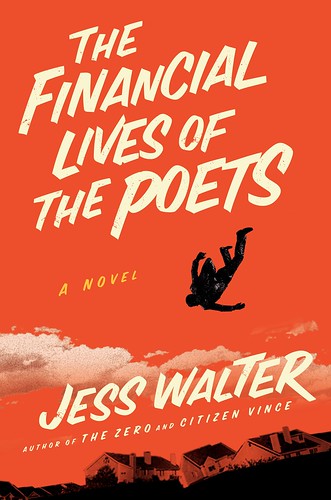
The Financial Lives of the Poets (and everyone else too)

Many of us have been affected in some way by the recent economic depression, and Matt Prior the hero of Jess Walter's The Financial Lives of the Poets is no exception. When we meet him, his life is nearly in ruins - the book was just published last year and is set in our current depression. The protagonist is only days away from losing his home, he has no job, his family is deeply in debt, and he suspects that his wife is being unfaithful. You'd think that things couldn't possibly get any worse.

Interestingly enough, the day before I began reading The Financial Lives of the Poets, I heard a story on NPR talking about California's financial woes, and suggestions by some that legalization of marijuana for recreational use could alleviate some of these problems. In this context, Matt Prior's decision to become a drug dealer to save himself from economic downfall seems less satirical than it may from a distance. This is something that I am especially fond of in this novel - the concerns of the main characters are immediate. (One can only hope that the economy will improve enough to make this book seem dated in just a couple years.)

Whenever I read a book/essay/article that is meant to be at least mildly satirical, my mind slowly drifts to Jonathan Swift's A Modest Proposal (which I love dearly). These two pieces aren't so very different. Neither author is actually promoting the solutions that are presented in their respective works, but both are presenting a challenge: Let's come up with a better or more realistic solution.

As Matt Prior exacerbates his situation, we root for him. After all, he wants the same things that many of us want; a comfortable home and security for his family. Hopefully those who read this novel will learn from Matt's mistakes - he reminds us that life isn't about things but about the people with whom you share them.

Wednesday, February 10, 2010

Rebecca by Daphne Du Maurier

This novel begins in Monte Carlo when our unnamed heroine meets Max DeWinter (Maxim), a handsome widower. Rebecca is his recently deceased wife. The two marry after a very brief courtship and they return to his elegant estate, Manderley. Rebecca’s presence is still very strong in the house, and our heroine gradually learns more about her predecessor and her husband’s past. It is easy to relate to the awkwardness that the heroine must feel, constantly being compared to the graceful, beautiful Rebecca.

For as long as I can remember, awkward situations in television, movies and books have embarrassed me. There were scenes in the first half Rebecca that just made me want to cringe; Du Maurier’s heroine is so naïve and innocent that her actions just seem foolish. I am embarrassed for her. I had to stop multiple times to remind myself that it is fiction.

Without going into too much detail, I felt conflicted near the end of the book. I’m of the opinion that domestic violence is never okay and people never “deserve it.” Yet it is written in a way that portrays this in a sympathetic light. Other popular books that are out now (for example the Twilight saga) also seem to be sympathetic to people who are moderately aggressive in relationships, and I wonder if I only hold this opinion because I’ve recently been thinking about the effect of abuse in literature. I would be curious to hear whether others who have read Rebecca are similarly conflicted.

Monday, February 1, 2010

Seriously? L.A. Candy by Lauren Conrad?

Though it is a book in the traditional sense, L.A. Candy isn’t the kind of book that really needs to have a book review written about it. Based on the title and the background of the author (she’s on MTV’s The Hills for those of you who don’t know), most people probably know just about everything they need to about this novel. This isn’t necessarily a negative thing though, either you like the occasional scandalous, girls’ novel about sex, love and the L.A. party scene or you don’t.

This book is about Jane Roberts and her best friend Scarlett who move to Los Angeles to work for a party planner and attend college, respectively. At a club, the girls are discovered by a producer for a mysteriously named television station (PopTV), and invited to participate in a new reality show that he is planning. Of course, the show is a success and the girls quickly become famous. Don’t start this book if you aren’t prepared to commit to reading the series – L.A. Candy has a cliffhanger ending, so readers will also want to check out Conrad’s next book, Sweet Little Lies.

I feel confident in saying that Lauren Conrad doesn’t know who Descartes or James Joyce are, and she has never read Gabriel Garcia Marquez’s One Hundred Years of Solitude, but she talks about this literature as if she were familiar with it. These references just add to the fun; I shake my head and wonder what the editors were doing. I think the assumption that someone “helped” her to write this book is pretty safe, but for the purposes of this review, I’ve referred to Conrad as an author.

As with all sweets, L.A. Candy isn’t especially healthy and should be enjoyed in moderation. (How's that for a cheesy end to a review?)